
You pull the patio door shut, turn the handle, and nothing catches. Or it only locks if you push the panel up and sideways at the same moment. Most people assume the lock has died and start shopping for a new one. Often the lock is fine. It’s just the first part to show that something else has gone wrong.
At MasterKey Locksmith Glass & Doors, we get asked whether a sliding patio door lock repair or a full replacement is the better call. The answer depends on which part is actually failing, so here is how to read the symptoms.
Why your sliding patio door lock isn’t working
1. It locks with the door open but not when it’s closed
Open the door and turn the handle. If the hook swings out and back smoothly, the lock mechanism is probably healthy. The trouble starts when the door closes and the hook has to land inside the keeper on the frame.
If the hook hits the edge of the keeper, the panel has usually dropped slightly or the keeper has shifted. Look for fresh scratches or a shiny scuff on the keeper where the hook has been striking. Don’t just move the keeper to chase the hook. If the panel is sagging, you’ll be repositioning it again in a few months.
2. You have to lift the door or push on it to lock it
This usually points to the panel sitting too low. Most sliding panels have adjustment screws near the bottom edge that raise or lower the door on its rollers. When the rollers wear or the screws drift, the hook no longer meets the keeper at the right height. Lifting the door pushes it back into position for a moment, which is why the lock catches.
A loose keeper or a worn hook can cause the same thing, so confirm the cause before you buy parts. Lifting the door every night is also hard on the lock and the handle.
3. The handle turns but the hook doesn’t move
That points to a fault inside the door. On many doors the handle drives the lock body through a small spindle or linkage, and either can loosen, strip or snap. Some doors have a separate handle and lock body, and others use a single combined unit. A new handle won’t fix a broken lock body, which is why swapping the handle alone often disappoints.
4. The door scrapes or feels heavy
Dirt and grit in the track are the easy explanation, and you can deal with them yourself. A vacuum and a stiff brush will clear most of it. If the panel still drags, stop forcing it. A dragging door usually means the rollers need attention, and pushing it shut can bend the hook or strain the frame. A panel that doesn’t sit properly will also keep missing the keeper, however good the lock is.
A real job: a patio door that would not lock
A customer called because his patio door wouldn’t lock. He’d close it, try to lock it, and it simply stayed open.
Our technician went out and replaced the lock mechanism, then adjusted it so it lined up properly with the frame. He also replaced the door’s wheels. So this wasn’t only a lock problem. The mechanism, its alignment with the frame and the wheels all needed attention, which is why we check the whole door before quoting a replacement.
On the same visit the customer wanted a digital keypad lock on another door that had none. That meant a fresh installation. The technician drilled a new hole in the door, then chiselled out the wood on both the door and the frame so the new lock fitted cleanly and worked smoothly.
 Which patio door lock do you have?
Order the wrong lock and it won’t fit, so identify yours first.
Most sliding doors use a mortise hook lock. It sits inside the vertical edge of the panel, and the handle or thumb-turn swings a hook into the keeper on the frame. When you match a replacement, check the lock body size, the backset (the distance from the panel edge to the handle’s centre), the faceplate length and width, which way the hook faces, and the spacing between the handle screw holes.
Some doors have a surface-mounted lock that bolts to the face of the panel instead. For these, the mounting holes and the clearance around the lock matter most.
The keeper is the metal catch on the frame that receives the hook. A loose or damaged keeper can stop a good lock from locking.
Two locks can look identical and still differ by a few millimetres. Photograph the handle, the faceplate on the panel edge and the keeper before you buy anything. The faceplate often has a manufacturer’s stamp.
What you can check at home?
- With the door open, turn the handle gently and watch the hook move.
- Look at the keeper for loose screws, damage, or scuff marks from the hook.
- Clean the track where you can reach it.
- Check the panel for uneven gaps, scraping, or one corner sitting lower than the other.
- Notice when the problem happens: every time, only when the door is closed, or only when you push or lift.
Don’t force the handle, bend the hook or take things apart near the glass. If the answers are unclear, an inspection will find the cause faster than guessing.
When repair is enough?
Repair makes sense when the lock itself still works and something around it has gone wrong. That might be a loose keeper, a handle part you can replace on its own, or a panel that needs adjusting on its rollers. If the hook is fine and just misses the keeper, correcting the alignment matters more than fitting a new lock.
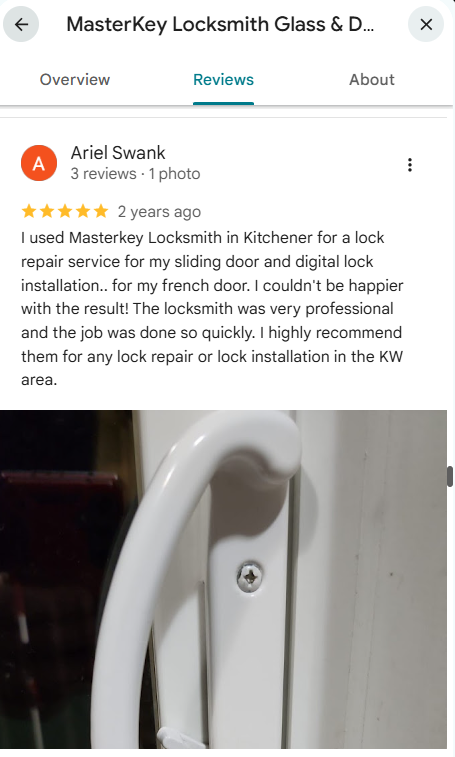
The goal is to fix the cause, not just make the lock catch today. Ariel Swank had MasterKey repair the lock on her sliding door, and wrote in her Google review, “I couldn’t be happier with the result!” If the mechanism is broken inside, the hook is badly worn, or the same fault keeps coming back, replacement is the better choice.
When to replace the lock?
Replace the lock when the body is broken, the hook no longer moves properly, or repair parts can’t be found. Before you order, match the backset, the faceplate, the hook direction and the handle hole spacing, and check that the new lock works with your keeper.
Older doors are the hard ones. The original hardware may no longer be made, and you may need a close alternative that fits. We confirm the fit before installing anything, and we check the alignment too, because a new lock on a sagging panel will start missing the keeper again. You can see more of what we handle on our windows and doors page.
Patio door lock repair cost: what affects the price
The patio door lock repair cost depends mostly on what is wrong. Re-securing or adjusting a keeper is a small job. Replacing a broken mortise lock is bigger, especially when the original is hard to source. If the rollers, track or panel alignment also need work, the total goes up.
We give you an estimate before any work begins, and we get your approval before changing the price. To get a quote, contact us and describe whether the handle turns, whether the lock works with the door open, and whether you have to lift the panel to lock it. Photos of the handle, the door edge and the keeper help. Ask what the price includes: parts, labour, alignment work and testing after installation.
Sliding patio door lock installation in Kitchener, Waterloo and Cambridge
Good sliding patio door lock installation starts with identifying the existing lock and checking the panel, rollers and keeper. The new lock should fit snugly, engage fully, and work without muscle. Vigneshwaran Kumaragurubaran wrote in his Google review that we “did a very good job on installing the new lock” on his patio sliding door.
We serve Kitchener, Waterloo and Cambridge, as well as Guelph, Ayr, Elmira, Baden, Wilmot and New Hamburg. Describe the symptoms when you call, and send photos if you can.
After any repair or replacement, the lock should go through several full open, close and lock cycles. The door should glide, and the hook should engage without forcing the handle. Krishna Chaitanya Nuthi, who had a patio door lock installed, described the technician as “very professional and experienced” and said the job came with a warranty.
Frequently asked questions
1. Why does my patio door only lock when I lift it?
The panel is probably sitting too low, often because the rollers are worn or need adjusting. The hook then misses the keeper by a few millimetres. A loose keeper or worn lock can cause it too. Lifting is a useful clue, but get the rollers and keeper checked before you pick a repair.
2. Can I replace just the latch instead of the whole lock?
Sometimes. If the latch is a separate part and a matching one exists, you can replace only that. On many mortise locks, though, the hook is built into the lock body, and you replace the whole unit.
3. Why won’t my new handle lock the door?
The handle isn’t the only part involved. A new handle can’t fix a broken lock body, a keeper that’s out of position, or a panel that sits too low. All three need checking together.
4. Can cold weather make a sliding patio door lock hard to use?
It can contribute. Cold changes how materials sit, and a door with a marginal alignment problem can show it in winter. But don’t blame the weather without checking. Clear the track, look at the panel alignment, and have the hardware inspected if it keeps happening.
5. How do I find the right lock for an older sliding door?
Photograph the handle, the lock edge and the keeper. Write down any manufacturer marks, and measure the backset and the spacing between the handle holes. Check compatibility before buying, especially if the original model is discontinued.
6. Is it safe to leave a patio door that won’t lock?
No. A door that doesn’t lock is effectively unlocked, so arrange a repair soon. Don’t force the mechanism in the meantime. For a stopgap overnight, a cut-to-length dowel or broom handle in the track stops the panel from being slid open from outside, and you can pull it out easily from inside, so it doesn’t block your exit.
Need help with your patio door lock?
MasterKey Locksmith Glass & Doors offers 24/7 locksmith service across Kitchener, Waterloo and Cambridge.
- Phone: 519-857-3138
- Email: ontario.locksmith.services@gmail.com
- Contact page: Get a quote